Guyana and Suriname: The New Frontier Reshaping Atlantic Basin Drilling

Updated: Jul 1
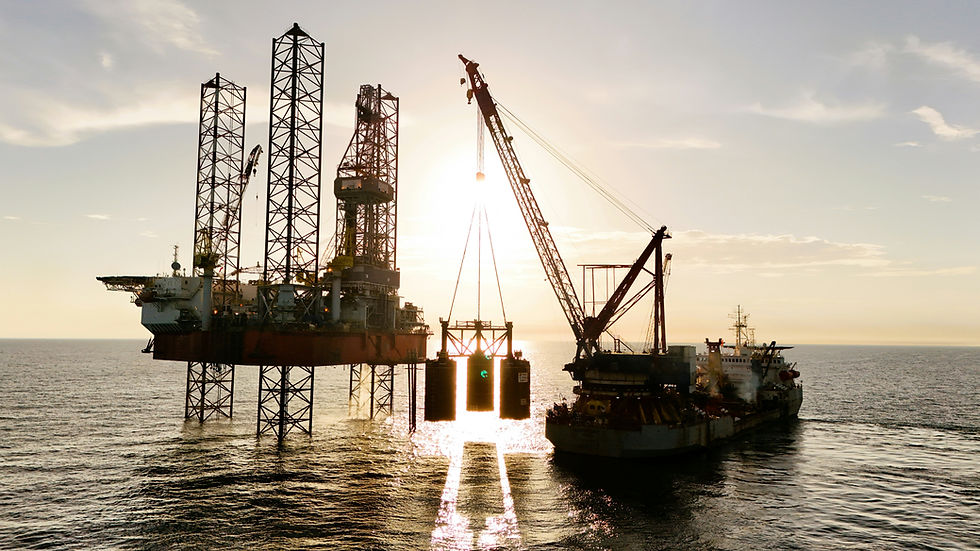
A decade ago, Guyana was not on the radar of most international drilling consultants. Today, the Stabroek Block has become one of the most consequential offshore petroleum provinces in the world, and its neighbor Suriname is rapidly emerging as the next chapter in what geologists are calling the Atlantic Basin supercycle.
As someone who closely tracks frontier drilling activity, I want to provide an honest assessment of what is happening in this region, why it matters to the global supply picture, and what operational and geopolitical factors companies entering or expanding in this basin should understand.
The Stabroek Block alone has materially shifted projections for global deepwater supply. No other single discovery province in the last ten years has had the same combination of scale, quality, and deliverability.
The Scale of the Discovery
ExxonMobil, Hess, and CNOOC's Stabroek operations have delivered over 30 significant oil discoveries to date, with recoverable resource estimates now exceeding 11 billion barrels of oil equivalent. Production from Liza Phase 1 and 2, along with Payara, has established Guyana as a top-tier producing nation in a remarkably compressed timeframe.
For context: Guyana went from first discovery in 2015 to first oil in 2019 - roughly four years from exploration success to production. That pace is exceptional by any standard and reflects both the quality of the reservoir and the operational effectiveness of the development team.
Suriname's Block 58, operated by TotalEnergies and APA Corporation, confirmed a working petroleum system with discoveries at Maka Central, Sapakara, and Kwaskwasi. The reservoirs are analogous to Guyana's Liza fields across the geological basin, and development planning is advancing with FID decisions expected in the near term.

Operational Realities
Drilling in this part of the Atlantic basin comes with specific challenges that are not always captured in the high-level narrative. Water depths range from 1,500 to 2,500 meters, requiring sixth- and seventh-generation drillships with full managed pressure drilling capability. The distance from established supply chains and skilled workforce centers in Trinidad, Brazil, and West Africa adds logistical complexity.
Wellbore stability in the turbidite sand reservoirs has been generally favorable, but well construction programs must account for high overburden pressure and the unique directional challenges of targeting elongated channel systems. Extended-reach lateral sections in development wells demand rigorous T&D planning and ECD management.
The regulatory environments in both countries are still maturing relative to established basins. Guyana's Petroleum Commission and Suriname's Staatsolie are building institutional capacity, but operators still encounter permitting timelines and local content requirements that add lead time to project planning.
The Geopolitical Dimension
The rapid development of Guyana and Suriname is not happening in a geopolitical vacuum. This basin sits at the intersection of U.S. strategic interests, Chinese investment positions, Venezuelan territorial ambitions, and a shifting regional order that Trinidad and Tobago is trying to navigate while its own energy future becomes increasingly uncertain. For operators and investors, understanding these dynamics is not optional - they directly affect insurance costs, workforce logistics, rig availability, and long-term project viability.
Venezuela: From Territorial Threat to Political Rupture
The Venezuela dimension of this story has been transformed fundamentally since early 2026, and any analysis that does not reflect this reality is already out of date.
On January 3, 2026, U.S. military forces conducted what the Trump administration called Operation Absolute Resolution - a direct military incursion into Caracas that resulted in the capture of Nicolás Maduro and his wife Cilia Flores. Maduro appeared before U.S. District Judge Alvin Hellerstein on January 5, entering not guilty pleas to charges of narco-terrorism conspiracy, cocaine-importation conspiracy, and weapons possession. He is currently in U.S. custody awaiting trial - an outcome that would have seemed impossible two years ago and that has no modern precedent for a sitting head of state in the Western Hemisphere.
The immediate consequence was the elevation of Vice President Delcy Rodríguez as Venezuela’s acting president. Rodríguez - herself previously sanctioned by the U.S. during Trump’s first term for her role in undermining Venezuelan democratic institutions - has moved quickly to reposition Venezuela’s relationship with Washington. In April 2026, the Trump administration lifted her individual sanctions, removed her from the Specially Designated Nationals list, and began rolling back broader oil sector restrictions to allow American companies to invest in Venezuelan production infrastructure. Rodríguez has publicly supported opening Venezuela’s oil industry to foreign private investment and signaled a desire for normalized relations with the United States - a dramatic reversal from the Maduro era’s posture.
For the Guyana-Suriname basin, the implications are immediate and complex. The removal of Maduro - who drove the Essequibo territorial escalation as a domestic political distraction - reduces the risk of military provocation from a destabilized, isolated regime. On the other hand, the Rodríguez government traveled to The Hague in May 2026, just days ago, to defend Venezuela's territorial claim before the ICJ in the closing session of oral arguments. Venezuela's position has not softened: Rodríguez explicitly stated that Venezuela will not accept any ICJ ruling affirming the validity of the 1899 Arbitral Award that established the Guyana boundary. The dispute remains unresolved at the institutional level even as the political temperature has cooled. A critical point often overlooked in commercial analysis: even a ruling fully favorable to Guyana would establish only terrestrial boundaries. The maritime boundaries - which govern the offshore areas currently under active exploitation - would remain subject to separate future negotiation and determination between the two countries. The oil-producing blocks are not automatically settled by an ICJ land boundary ruling.
Regional analysts tracking the closing arguments are already questioning what the ICJ ruling - expected within months - will mean for hemispheric energy stability. Venezuelan legal scholar Adolfo P. Salgueiro, writing for El Nacional on May 16, 2026, assessed the probable outcome as unfavorable to Venezuela on the territorial question, and noted explicitly that any adverse ruling will directly complicate the maritime and submarine delimitation facing the coast "where the world's largest unexploited petroleum basins lie" (Salgueiro, 2026). This reinforces what operators already know: the offshore oil-block picture is not resolved by a land boundary ruling, regardless of outcome.
It is important to place the current ICJ case in its full historical context. The Venezuela-Guyana territorial dispute predates both Chavez and Maduro by decades. Otalvora (2002), in his academic analysis of Venezuelan Caribbean foreign policy, documents how Caracas pursued the Essequibo claim through every democratic administration since the 1966 Geneva Agreement - including cooperative governments that simultaneously used oil diplomacy and economic cooperation to court small Caribbean states. Through successive UN-mediated Good Offices processes, the dispute was kept in managed diplomatic limbo rather than escalated militarily. Critically, the CARICOM bloc has consistently sided with Guyana in multilateral forums: when Venezuela attempted to use oil supply as political leverage against Georgetown in 2000, the entire Caribbean community closed ranks behind Guyana. What changed under Maduro was the weaponization of the territorial claim as a domestic political distraction - not the existence or legal standing of the claim itself. The Rodriguez government's continued pursuit of the ICJ case is a continuation of Venezuelan state policy that predates the current transition, not an aberration or a negotiating posture. Industry planners should treat this as a structural feature of the operating environment, not a temporary political complication.
The longer-term uncertainty - what a stabilized Venezuela with recovering oil production looks like as a neighbor and competitor to Guyana - is a question the industry is only beginning to work through. A Venezuela that successfully reopens to international capital and rebuilds PDVSA even partially would add significant non-OPEC supply to the Atlantic Basin picture and compete directly for the deepwater engineering talent and drillship capacity currently concentrated in Stabroek and Block 58.
Trinidad and Tobago: The Regional Hub Watching Its Own Clock
Trinidad and Tobago occupies a unique and uncomfortable position in this regional picture. For decades it was the Caribbean's dominant energy economy - home to Atlantic LNG, one of the world's first large-scale LNG export terminals, and a sophisticated network of service companies, engineering firms, and drilling professionals that supplied much of the regional industry. That infrastructure and that workforce are now the backbone of Guyana and Suriname operations.
The problem is that Trinidad's own gas reserves are in structural decline. Production from the mature fields supplying Atlantic LNG has been falling for years, and the country is managing an increasingly difficult balance between sustaining current LNG commitments and developing enough new supply to remain relevant. Heritage Petroleum, the national oil company, is pursuing infill drilling and enhanced oil recovery on mature assets, but the scale of new supply needed to reverse the trend is not yet visible in the development pipeline.
The Dragon gas field is the most pointed illustration of Trinidad's geopolitical exposure. Dragon straddles the maritime boundary with Venezuela, with the majority of reserves on the Venezuelan side. Negotiations between bpTT and the Venezuelan government had been advancing toward a development agreement when U.S. sanctions on Venezuela complicated the financing and offtake structure. A temporary OFAC license was issued to allow limited engagement, but the long-term framework remained unresolved - leaving one of T&T's most significant near-term gas development opportunities frozen between U.S. sanctions policy and Venezuelan political dysfunction. The post-Maduro transition and the partial sanctions rollback under Rodríguez may now create a new opening for Dragon, but the legal and commercial framework will need to be rebuilt from scratch under the new political reality.
Trinidad's political leadership is walking a careful line: maintaining the U.S. relationship that underpins its LNG trade and financial system while trying to develop pragmatic energy arrangements with Venezuela that could extend the country's gas production horizon. It is a position that grows more difficult as Guyana's success demonstrates what competent governance and stable international investment frameworks can produce just across the basin.
American Strategic Interest: More Than Market Access
The U.S. interest in Guyana and Suriname goes well beyond oil supply diversification, though that matters. Both countries are central to a broader U.S. strategy of reducing hemispheric dependence on OPEC supply and limiting Chinese and Russian economic influence in Latin America and the Caribbean.
ExxonMobil's dominant operatorship in Stabroek - holding 45% of the block and effectively controlling the development program - is not a coincidence from a strategic standpoint. The U.S. government has been active in Guyana on transparency, governance, and institutional capacity-building, with an explicit interest in ensuring that Guyana's oil wealth does not replicate the Venezuelan pattern of resource mismanagement and political capture. Operation Absolute Resolution itself was the most unambiguous expression of U.S. intent to actively shape the regional political environment rather than manage it from a distance.
The CNOOC dimension adds direct tension. CNOOC holds a 25% equity stake in Stabroek, giving China a direct financial interest in the most important new offshore oil province in the Western Hemisphere. CNOOC has been designated on the U.S. Department of Defense's list of companies allegedly affiliated with Chinese military activity, creating compliance and political risk overlays for institutional investors subject to U.S. regulatory scrutiny. The Hess-Chevron transaction - through which Chevron sought to acquire Hess's Guyana stake - became the most prominent example of how geopolitical considerations are now embedded in deal structures in this basin, with arbitration proceedings over pre-emption rights functioning as a high-profile test of how the Stabroek consortium governance handles major ownership transitions under strategic pressure.
What This Means for Global Drilling
The Atlantic Basin discoveries have added meaningful non-OPEC supply growth to the global picture. Goldman Sachs and IEA forecasts have repeatedly been revised upward for this region. The activity is sustaining demand for deepwater drillships, subsea equipment, and specialized engineering services. The geopolitical dynamics described above add a layer of complexity that purely commercial analysis does not capture - but they also underscore why this basin will remain strategically significant regardless of where the oil price cycle sits at any given moment.
For drilling consultants and operators looking at this region, the message is clear: the frontier phase is transitioning to a mature development phase in Guyana, while Suriname offers genuine early-mover potential. Both require the combination of deepwater engineering depth, logistical planning sophistication, and geopolitical awareness to execute effectively.
WillCo Perspective
At WillCo, we track frontier basin development not just for market intelligence but because our clients need accurate context when making decisions about rig contracting, well program design, and service provider selection in emerging regions. Understanding what is happening in Guyana and Suriname is increasingly relevant even for operators not directly involved, because it influences global drillship availability, day rates, and the allocation of deepwater specialist expertise.
References
ExxonMobil (2025). "Guyana Development Update – Stabroek Block." ExxonMobil Investor Relations.
2. International Energy Agency (2025). "Oil Market Report – Non-OPEC Supply Outlook." IEA, Paris.
3. TotalEnergies (2025). "Suriname Block 58 Development Update." TotalEnergies SE.
4. Reuters (2025). "Guyana oil output hits record as Payara ramp-up accelerates." Reuters Energy.
5. SPE-214802-MS. "Deepwater Well Construction Optimization in the Guyana-Suriname Basin." SPE, 2025.
6. Wood Mackenzie (2025). "Atlantic Basin Supply Outlook: Guyana, Suriname, and Brazil." WoodMac Research.
7. International Court of Justice (2024). "Arbitral Award (1899) (Guyana v. Venezuela)." ICJ Reports.
8. NPR (2026). "U.S. lifts sanctions on Venezuela's acting President Delcy Rodríguez." NPR, April 2026.
9. Atlantic Council (2026). "The U.S. just captured Maduro. What's next for Venezuela and the region?" Atlantic Council, January 2026.
10. Al Jazeera (2026). "Venezuela's Delcy Rodríguez heads to The Hague for land dispute case." Al Jazeera, May 9, 2026.
11. World Oil (2026). "Offshore oil dispute drives Venezuela-Guyana case at International Court." World Oil, May 10, 2026.
12. CBS News (2026). "Trump administration lifts sanctions on Delcy Rodríguez, Venezuela's acting president." CBS News, April 2026.
13. Otalvora, Edgar C. (2002). "El Caribe y el contencioso con Guyana en la politica exterior venezolana: contraste de dos tiempos." Cuadernos del CENDES, v.19, n.49, Caracas, enero 2002. https://ve.scielo.org/scielo.php?script=sci_arttext&pid=S1012-25082002000100006
14. Salgueiro, Adolfo P. (2026). "El caso del Esequibo esta culminando, que nos espera?" El Nacional, Caracas, 16 de mayo de 2026. https://www.elnacional.com/columnas/2026/05/el-caso-del-esequibo-esta-culminando-que-nos-espera/


Comments