The Offset Well Fallacy

Offset analysis can compare the wrong wells when proximity is treated as similarity. Distance on a map is the weakest reason to trust a lesson.

🖥️ Four wells on a screen
An engineer is planning the next well. She opens the database, finds the four nearest wells on the map, scrolls through their drilling parameters, and carries a handful of lessons forward: watch the losses around nine thousand feet, pick up the mud weight before the shale, budget an extra day for the reaming. The program goes out. It is competent work, and it is almost exactly how offset analysis was done twenty years ago.
The archive behind her screen has moved on. There may be decades of wells in it, each one carrying thousands of channels, event logs, and driller notes. The method sitting on top of that archive is a day old. It treats a deep quantitative record as a reference shelf: pull a few neighbors, read them by eye, and trust judgment to fill the rest.
This article makes the case for offset well analytics as a disciplined pre-well practice. Not real-time automation, nothing that touches a live control loop. Historical data mining, done well. The argument has a sharp edge to it, and it belongs up front: the wells chosen because they were close may not be the wells that best predict the next hole, and treating proximity as similarity is the quiet error that makes an offset study feel rigorous while pointing it at the wrong evidence.
🎯 What offset analysis is supposed to do
Offset well analysis has one job: to reduce the uncertainty in the next well by learning from wells already drilled. Where will the trouble zones be, how should the mud program step through them, where do the casing points want to sit, which bottom-hole assembly behaved and which one fought the formation. Every one of those questions has already been answered, somewhere, by a well that has been drilled.
The instinct is to treat that body of wells as a lookup: find the closest match, read off the answer. The move this article argues for is to treat it as an analytical asset. The difference is not software. It is whether the archive is queried as evidence, with a defensible method for deciding what counts as comparable and what a recurring problem actually implies for the next design.
WillCo analysis. The industry has already noticed that the manual version is fragile. A patent publication on offset-well selection notes that trajectory similarity is often assessed from wells near the planned location using basic filters, leaving offset analysis as a time-consuming manual review of geographically close wells. That is not a criticism of engineers. It is a reason to make the selection criteria explicit and reproducible, because when the step is left to habit, the habit is distance on a map.
The terminology should change with the method. An offset well is simply a historical well available for comparison. An analog well is one that has earned its place in the comparison set through geological, trajectory, design and operational similarity. The first term describes location and availability; the second describes relevance. From this point forward, this article uses offset wells for the candidate pool and analog wells only for the wells that pass a defensible similarity assessment.
🧭 Which wells are actually analogs
Here is the fallacy stated plainly. The nearest wells on the map are selected because they are easy to find, not because they resemble the well being planned. Two wells a mile apart can penetrate a different formation sequence, land at a different inclination, run a different bottom-hole assembly, and drill on a different mud system. Nothing about the distance between them says they will behave alike, and the lessons that travel between truly similar wells do not respect a radius drawn on a plan view.
A genuine analog is defined by what the bit and the wellbore actually experience, and that is a question of several dimensions at once rather than one. The ones that carry the most signal are consistent across any drilling program.
🪨 Geology. Formation tops, thicknesses, and the sequence the well drills through, including the reactive or depleted intervals that drive most trouble. Two wells that share a stratigraphic column have far more to say to each other than two wells that merely share a county.
📐 Trajectory. Vertical, build, or extended-reach, with the inclination and dogleg profile the well actually ran. A long lateral and a vertical pilot in the same section are not the same drilling problem.
🧱 Hole size and casing architecture. The section sizes and where the casing points landed, which set the mechanical envelope every lesson sits inside.
⚙️ BHA and mud system. The assembly type and the fluid, because the same formation drilled with a different motor, bit, or mud chemistry can produce an entirely different set of events.
Cluster the archive on those dimensions and the picture inverts. Some of the map-nearest wells drop out, because once geology and design are accounted for they are not analogs at all. And wells from farther away, sometimes a different pad or a different field, come forward as the real comparison set. The point of the exercise is to let the data decide similarity, instead of letting the plan view decide it by default.
A further refinement sharpens the point: the analog relationship is earned section by section, not fixed for a whole well. The well that best matches the surface hole, drilled through the same shallow sequence on the same trajectory, may have little to say about the reservoir section, where a different well, sometimes in another field, shares the formation, the hole size, and the mud system that actually govern at depth. Clustering well by well is the first pass. The honest version clusters by hole section, so each interval of the next well is planned against the wells that are genuinely comparable there, rather than against one well forced to stand in for the entire hole.
The mechanics are the same at either level, and they are worth stating plainly, because the discipline lives in the detail. The features are normalized so that a depth in thousands of feet and an inclination in degrees carry comparable weight, each dimension is weighted by how strongly it drives drilling behavior, and wells are ranked by a distance metric that yields a single similarity score rather than a yes-or-no match. Wells missing a key attribute are flagged, not silently dropped or filled with a guess. An engineer reviews the ranked set before it is used, because the method is built to inform judgment, not replace it. And the result is tested for sensitivity: if a small change in the weights reshuffles the analog set, that fragility is itself a finding about how far the plan should lean on it.
🔄 The analog set is rebuilt for every well, not stored once
In many conventional workflows, offset wells are still selected by proximity or by a limited directional match. That is a subjective, single-factor screen, and the selected wells may not be truly comparable. Clustering changes the question from what is close to what is comparable: the reference set is built from directional profile and casing design, formation pressures and mud weight, and the problems actually encountered in each well, so what comes out is a multifactor similarity index, not a distance on a map.
That weighting cannot be frozen into one permanent model. Every planned well changes the question, and the analysis should be rebuilt for the target well and, where appropriate, for each hole section. A machine-learning workflow can re-evaluate the candidate pool, select and normalize the relevant features, update their weights, recalculate the clusters, and rerank the wells as the design context changes. Formation sequence, depth, inclination, trajectory shape, hole size, casing architecture, mud system, BHA, operating history, and other operational factors that the complexity of the well may warrant will not carry the same importance in every analysis.
That does not mean relabeling the entire archive for every run or handing the decision to an opaque model. Stable labels, including formation, hole section, BHA type, mud system and event class, should be governed and reused. What changes is the target-specific analytical configuration: the feature set, normalization, weighting, cluster boundaries and similarity ranking. The machine performs the multidimensional comparison at a scale that manual review cannot apply consistently; the engineer defines the objective, validates the data and confirms that the resulting analogs make physical sense.
For the business, the payoff is the one the plan actually feels: references that are more objective, better designs, and less risk inherited from wells that only looked similar.

📊 From events to anomaly probability
Once the comparison set is honest, the next step is to stop reading events one well at a time and start reading them across the set. A single well tells you it took losses at a certain depth. The analog set tells you something far more useful: that losses recur in a particular formation, on most of the wells that drilled it, within a predictable depth window. One event is a case. Recurrence across comparable wells can be converted into an empirical frequency or, with an explicit model, a probability estimate.
That is the quiet power of the method. Recurring drilling problems, including stick-slip, pack-off, losses, kicks and stuck pipe, resolve into an anomaly-probability profile by depth and formation. The next well can then be planned against where the trouble is likely, not merely where one earlier well happened to hit it. The profile is a forecast built from real events, and it reads straight into the mud program, the casing design, and the risk register.
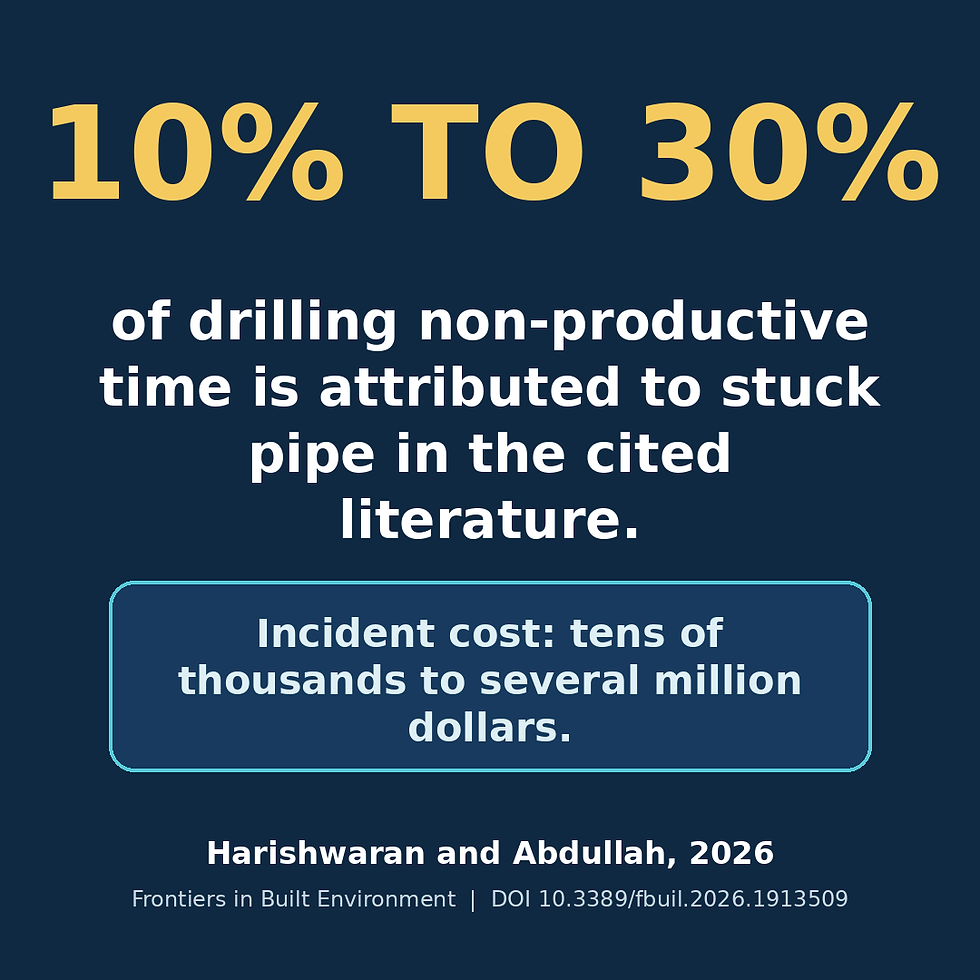
Stuck pipe is the clearest case for why this matters, because it is both common and expensive. A recent Frontiers paper reports that stuck pipe can account for 10% to 30% of non-productive time, with incident costs ranging from tens of thousands to several million dollars, citing earlier industry literature.
A number like that is not a reason to fear stuck pipe. It is a reason to locate it before spud. If the analog set says a reactive shale between two depths took pipe on most comparable wells, that interval stops being a surprise and becomes a planned-for zone, with the mud, the hole cleaning, and the tripping practice chosen for it in advance.

🧹 The data-quality reckoning
None of this works on data that has not been cleaned, and offset data is some of the messiest an operator holds. The method is only as trustworthy as the records feeding it, so the honest version of offset analytics spends real effort on the parts that are not glamorous. Four gaps do most of the damage.
⏱️ Reporting cadence. A dysfunction that a high-frequency stream would show as a clear signature can be invisible in a once-a-day morning report. When the analog set mixes wells recorded at very different rates, the events are not comparable until the cadence is reconciled.
📝 Buried driller notes. The real cause of an event is often sitting in a free-text remark the driller typed at the time, and free text is exactly what a tidy query skips. The most valuable sentence in the record is frequently the one no automated scan ever reaches.
⏲️ BHA timing gaps. Static data, the assembly details and the component changes, is sometimes logged well after the fact, so an event can be stamped against the wrong tool. If the analysis cannot trust when the BHA actually changed, it cannot cleanly attribute what the BHA caused.
🏷️ Inconsistent event coding. One well logs reaming, another logs hole enlargement for the same activity, and mnemonics drift between rigs and vendors. Until that vocabulary is reconciled, counting events across wells is counting different things and calling them the same.
Garbage offset in, confident wrong answer out. An analog study built on uncleaned records does not fail loudly: it produces a tidy profile that looks authoritative and quietly points the next well at the wrong risks. WillCo Drilling

🔁 Feeding it forward
An analog study earns its keep only when it leaves the analyst's screen and enters the next well's design. The output is not a slide. It is a set of inputs the program can act on.
What the analysis produces | Where it lands in the next well |
Anomaly-probability profile by depth and formation | The risk register, naming each likely trouble zone and the depth window it sits in. |
Recurring loss and kick intervals | The mud program and the casing-point selection, so the design steps through the zone rather than into it. |
BHA and bit performance across analogs | Assembly and bit selection, favoring what drilled the section cleanly on comparable wells. |
Stuck-pipe and pack-off history | Hole-cleaning and tripping practice written into the drilling program for the flagged intervals. |
The analog set itself, with its match basis | The pre-spud review, so the team can see which wells the plan rests on and why. |

That last row matters more than it looks. When the analog set is explicit and the basis for calling each well comparable is written down, the plan becomes something a team can challenge and defend, rather than a set of numbers whose origin is one engineer's memory. It is the same discipline this series has argued for everywhere else: a result you can trace is a result you can trust.
🛡️ Why this is the safest place to start
There is a strategic reason to begin a drilling organization's analytics here, and it has nothing to do with offset analysis being easy. It is that offset analytics is entirely pre-well and entirely historical. It reads the archive, produces a plan, and stops. In the workflow proposed here, the analysis is pre-well and advisory: it does not need access to the live control network or authority over a set-point, and it does not read live sensors.
That makes it a lower-risk, reviewable entry point into analytics for any operator still deciding how far to go. The work is done on data that has already been recorded, the output is reviewed by people before it is used, and the failure mode of a bad analysis is a plan an engineer can question, not an action a machine has already taken. An organization can build the data discipline, the cleaning, the analog method, the probability profiles, and earn confidence in it, entirely in the pre-well world before anything near real time is ever contemplated.
WillCo analysis. This is the whole case restated. As discussed in the ACIPET Academic webinar delivered by William Contreras, Artificial Intelligence in Drilling: From Well Records to Closed-Loop Systems, drilling analytics has two sides: a historical, pre-well side that mines the archive, and a real-time side that reads live sensors on a drilling well. This article has made the case for the first. The historical, pre-well side, specifically analog selection, clustering and anomaly-probability profiling, delivers real value without touching a live loop, which is exactly why it is where a cautious operator should start. The real-time side can wait until the historical one has proven the data and the method.
🗳️ The next well is a vote on the archive
Every well an operator drills is a quiet verdict on whether the organization learned anything from the wells before it. Drill the next hole against four wells picked for being close, and the verdict is that the archive is a filing cabinet. Drill it against a clustered analog set and a probability profile built from every comparable well on record, and the verdict is that the archive is an asset.
The offset well fallacy is not that engineers use offset wells. It is that the wells get chosen by distance and read by eye, when the data to choose them by similarity and read them by probability is already sitting in the record. Closing that gap does not require a new rig, a live feed, or a leap of faith into automation. It requires treating the wells already drilled as the evidence they are.
The wells you already drilled will tell you how the next one goes. The only question is whether you picked them because they were comparable, or because they were close. WillCo Drilling
Your offset wells are only analogs if the data says so.
📚 References and further reading
WillCo Drilling, "Where Did That Number Come From? Provenance and Lineage for Rig Data." willcodrilling.com
WillCo Drilling, "Clean Once, Trust Everywhere: Rig Data Cleansing as a Single Source of Truth." willcodrilling.com
WillCo Drilling, "Model Governance for Drilling AI: Provenance, Drift and Authority." willcodrilling.com
Harishwaran, R. and Abdullah M. A. "Machine-learning-based prediction of pipe-sticking events in petroleum drilling operations using domain-informed features and class-balanced ensembles." Frontiers in Built Environment, Vol. 12, 2026. DOI 10.3389/fbuil.2026.1913509. frontiersin.org
Maidla, E. and Haci, M. "Understanding Torque: The Key to Slide-Drilling Directional Wells." IADC/SPE-87162, 2004. onepetro.org
Dupriest, F. E. and Koederitz, W. L. "Maximizing Drill Rates with Real-Time Surveillance of Mechanical Specific Energy." SPE/IADC-92194, 2005. onepetro.org
Selveindran, A., Wesley, A., Chaudhari, N. and Pirela, H. "Smart Custom Well Design Based on Automated Offset Well Analysis." SPE Annual Technical Conference and Exhibition, SPE-201590-MS, 2020. onepetro.org
"Offset Well Analysis Using Well Trajectory Similarity." International patent publication WO2021029996A1, 2021. patents.google.com
Sheth, P. and Chatar, C. "New Techniques for Intelligent Offset Data Analysis Using Artificial Intelligence." IADC/SPE International Drilling Conference and Exhibition, IADC/SPE-217720-MS, 2024. DOI 10.2118/217720-MS. onepetro.org
Pillai, P., Ringer, M., Mangsuli, P. and Skvortsov, V. "Offset Well Identification and Parameter Selection." US patent application US20250052147A1, 2025. patents.google.com
Montes, A. C., Ashok, P. and van Oort, E. "Review of Stuck Pipe Prediction Methods and Future Directions." SPE Journal, 30(6), 3334-3363, 2025. DOI 10.2118/220725-PA. jpt.spe.org
Contreras, W. B. "Artificial Intelligence in Drilling: From Well Records to Closed-Loop Systems." ACIPET Academic webinar, 14 October 2026. youtube.com


Comments